



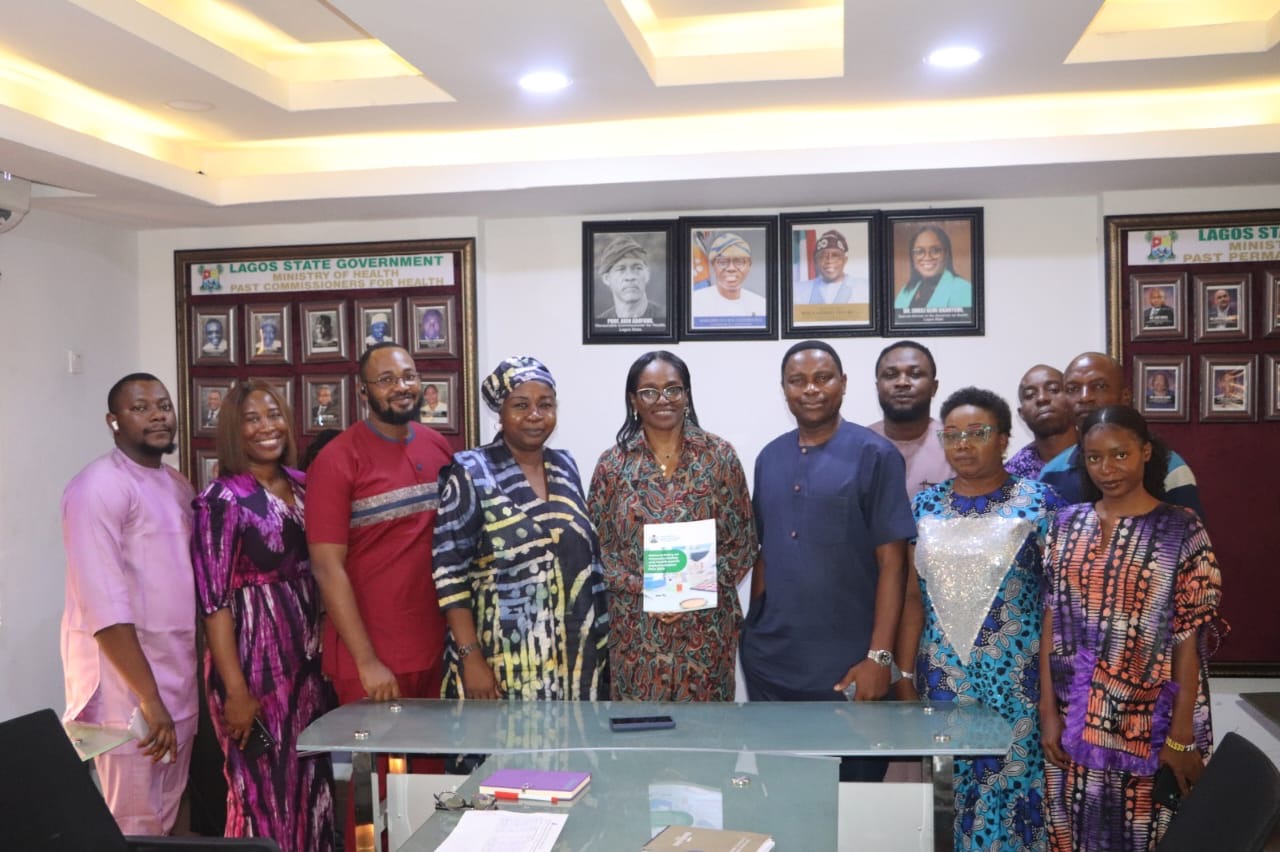
The Lagos State Government has taken a significant step toward strengthening the regulation of cosmetic products and procedures with the presentation of the National Policy on Cosmetics Safety and Health to the Special Adviser to the Governor on Health, Kemi Ogunyemi.
The policy was presented during the Exit Meeting of the Lagos State Engagement on Cosmetics Safety, held at the Lagos State Ministry of Health, marking the conclusion of a four-day stakeholder consultation that began on March 10 in Ikeja.
Speaking at the meeting, Ogunyemi said the timing of the engagement was critical, referencing a recent cosmetic surgery-related death in Lagos currently under investigation by the Health Facilities Monitoring and Accreditation Agency (HEFAMAA).
“This engagement could not have come at a better time,” she said. “Only this week, we recorded an unfortunate incident involving the death of a well-known individual following cosmetic surgery.”
She explained that authorities are investigating the circumstances surrounding the case, including the drugs used and their sources, emphasizing that patient safety remains a top priority for the state government.
“When even one life is lost, it signals that something has gone wrong, and such incidents must be prevented,” she added.
Ogunyemi assured stakeholders that the government would ensure comprehensive implementation of the policy across the entire cosmetics value chain, covering manufacturers, distributors, training institutions, and healthcare providers. She reiterated Lagos’ commitment to leading other states in adopting and enforcing the policy framework.
Also speaking, Paul Okhakhu of the Federal Ministry of Health and Social Welfare highlighted growing concerns over unsafe cosmetic products. According to him, the policy was developed in response to increasing cases of adverse health effects linked to adulterated, poorly formulated, or substandard cosmetic products.
“We have seen a rise in harmful reactions due to unsafe cosmetics, and the government is taking decisive steps to address this,” he said.
Okhakhu noted that the policy was validated in Lagos and later adopted at the 66th National Council on Health, providing a framework for regulatory action and state-level implementation. He further disclosed that a national monitoring dashboard is being developed to track progress, adding that Lagos was selected as a pilot state due to its strategic importance.
“If implementation succeeds in Lagos, it can be replicated nationwide,” he said.
In her remarks, the Director of Pharmaceutical Services at the Lagos State Ministry of Health, Olawale Poluyi, described the engagement as a key milestone, noting that it represents an important step in the policy’s implementation journey.
“Every journey begins with a step, and today marks an important step toward implementing this policy,” she said, assuring that the Ministry would translate the outcomes of the engagement into concrete actions.
The four-day engagement brought together 49 participants from federal and state agencies, regulatory bodies, academia, industry groups, cosmetology practitioners, civil society organisations, and the media. Together, they assessed the current cosmetics safety landscape in Lagos and developed a State Cosmetics Safety Action Plan aimed at reducing risks, strengthening regulation, and ensuring safer practices across the industry.